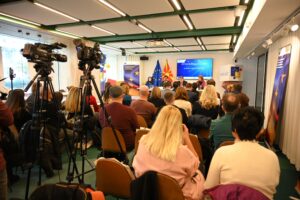
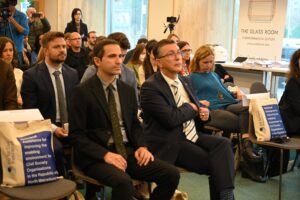
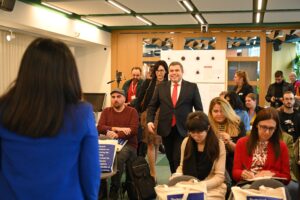
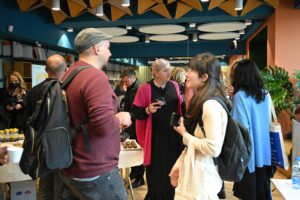
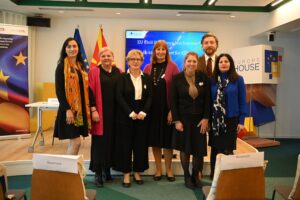
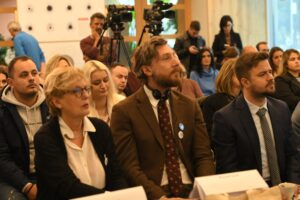
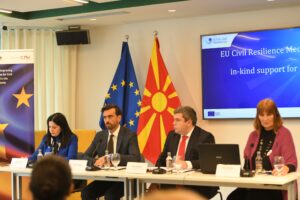
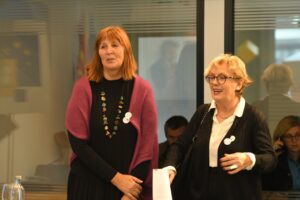
On 8th November 2022, the launching event of the Civic Resilience Mechanism took place in the Europe House, Skopje. Around 50 representatives of state institutions, embassies, CSOs and other relevant stakeholders gathered to learn about the new mechanism for in-kind support that targets the small local organisations in the country.
Mr. Steffen Hudolin, Head of Cooperation, Delegation of the European Union emphasized in his addressing that the civil society needs strategic support that will enable uninterrupted operation and constant capacity development of the CSOs. The EU introduces this funding mechanism for the first time in the country and it will provide resources for the smallest and least experienced organisations in the local communities. Mr. Hudolin informed that over the past two decades, the partnership between the EU and the civil society in the country had expanded. The main channel of support to the civil sector is the IPA Civil Society Facility established in 2008, providing support for many challenges the region is facing.
“I believe that civil society organisations, in a small country like ours, at a time when we are negotiating full membership in the EU, should be given space to participate and make their own contribution to the efficiency and effectiveness of the negotiations. The idea is to achieve this in accordance with the legal framework and of course without violating the independence and nature of their work” said Mr. Bojan Maricic, Deputy Prime Minister in charge of European affairs. He emphasized that as a representative of the Government and the current chief negotiator, he is fully aware of the key role of civil society in the negotiation process and for that reason, within the Decision to establish a negotiation structure for the accession of the Republic of North Macedonia to the European Union, an opportunity is foreseen for the civil society also to participate in the working groups.
Besides this launching event, fifteen information sessions on the CRM were delivered to local CSOs in all country regions – Bitola, Ohrid, Gostivar, Kumanovo, Kochani, Strumica, Kavadarci, Veles, Prilep, Tetovo, Kichevo, Kratovo, Delchevo, Gevgelija and Skopje. One online information session was also organized on the ZOOM platform. CSOs showed high interest and characterized the CRM as very suitable for small and inexperienced organisations who serve their local communities. The sessions gathered almost 300 participants who learned about the EU CRM and how to apply for this in-kind support.